
The African clawed frog, scientifically known as Xenopus laevis, is a remarkable amphibian native to Sub-Saharan Africa that has spread to many parts of the world due to its adaptability and use in research and the pet trade. This content will introduce its physical characteristics, habitat, behavior, diet, biology, reproduction, importance in science, impact as an invasive species, differences from related frogs, and other essential aspects.
What Is the African Clawed Frog?
The African clawed frog is a medium-sized, aquatic frog that belongs to the Pipidae family. Unlike many other frogs, it is fully aquatic, meaning it spends most of its life in water and only ventures onto land if forced to change habitats, usually during droughts. Its name comes from the three short black claws found on the inner toes of its hind feet, used for tearing apart food and digging.
Physical Description
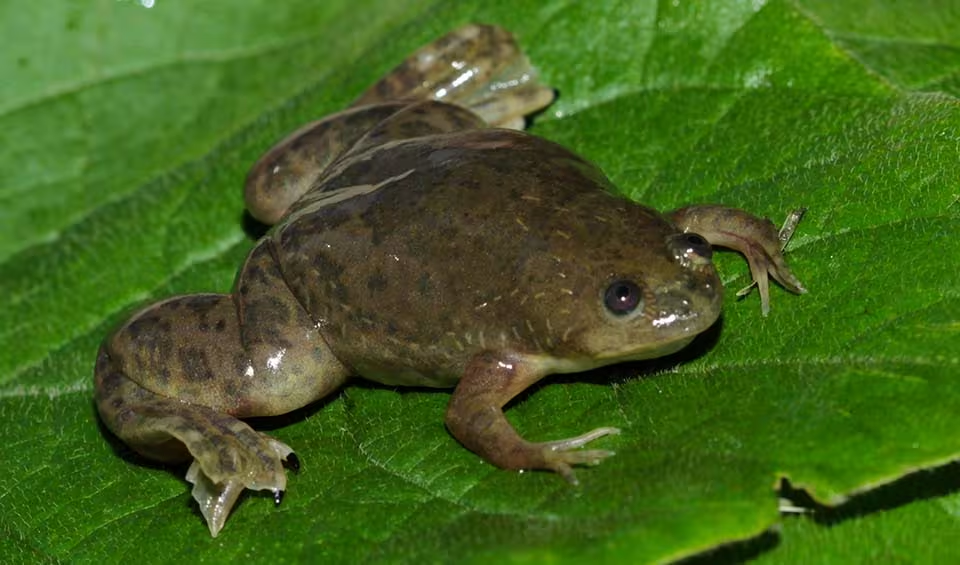
African clawed frogs generally have smooth and slippery skin, which ranges in color from olive green or brown to grey with mottled or spotted patterns. Some individuals may have yellowish blotches, and their belly is usually pale cream or white. Albino forms are common in labs and the pet trade. These frogs have large, webbed hind feet and unwebbed front legs with sensitive digits for grabbing prey. Their eyes sit on top of their heads, enabling them to see both above and below water at the same time.
Another unique feature is their lack of tongue and teeth — instead, they use their hands to shove food into their mouths. They also have a flattened look and no eyelids.
Key Differences from African Dwarf Frogs
Many pet stores confuse African clawed frogs with African dwarf frogs. The differences include:
- Clawed frogs have webbed hind feet, while the front feet have free digits, unlike fully webbed dwarf frogs.
- Clawed frogs have eyes at the top of the head; dwarf frogs’ eyes are located on the sides.
- The snout of a clawed frog is curved and flat, while a dwarf frog’s is pointed.
Habitat
African clawed frogs live in stagnant or slow-moving bodies of water—ponds, dams, and streams—in warm, grassland regions of Sub-Saharan Africa. These ponds are often covered in green algae and almost devoid of higher plant life. The frogs have a remarkable ability to tolerate a wide range of water salinity, pH, temperatures (from about 15°C to 26°C), and nutrient levels, which makes them extremely adaptable.
During wet seasons, the frogs may travel to other ponds or puddles in search of food or new habitat. In times of drought, they burrow into mud and become dormant, sometimes for up to a year.
Behavior and Life Cycle
African clawed frogs are primarily nocturnal, feeding and breeding during nighttime hours. They are carnivorous and opportunistic scavengers, eating almost anything that fits in their mouth — living or dead fish, tadpoles, crustaceans, worms, insects, and any organic matter. Their larvae are filter feeders, collecting nutrients from plankton.
Notably, these frogs exhibit cannibalistic behavior, sometimes eating their own larvae if other food sources are scarce. Adults detect prey using their sense of smell and the lateral line system (specialized sense organs sensitive to water movements), not by sight, though they can still watch prey or predators from the water’s surface.
When resting, these frogs either sit motionless on the substrate or float at the surface with their legs splayed and heads above water.
Biology
Adaptations
African clawed frogs are tongueless and toothless. Instead of vocal cords, males make underwater mating calls by contracting muscles rather than croaking. They also lack external eardrums; instead, they have cartilaginous disks beneath the skin that work similarly, enabling them to sense vibrations and sounds underwater.
Skin Shedding
The species get rid of their skin regularly (shedding) and eat their own shed skin for extra nutrients. This behavior is shared among many amphibians.
Longevity
These frogs can live for 15 years or more in the wild and up to 25–30 years in captivity.
Reproduction
African clawed frogs reproduce externally — the male fertilizes the eggs outside the female’s body. The mating ritual involves “inguinal amplexus,” where the male clasps the female just in front of her back legs until eggs are laid and then fertilizes them with sperm. These frogs can breed at any time of year if conditions are right.
Female frogs are larger and more rounded than males. Males, which have black patches on their hands and arms, use these to grab females during mating. Both sexes possess a cloaca, a common chamber for digestive, urinary, and reproductive tracts.
In the Wild
African clawed frogs are found in higher densities in artificial water bodies like dams and irrigation canals rather than natural lakes or rivers. They do not tend to prey on native amphibians but will eat their own larvae and face predation primarily from birds.
They also show the ability to colonize habitats at both lower and higher altitudes than previously thought, contributing to their success as an invasive species.
As an Invasive Species and Pests
Due to their adaptability and voracious appetite, African clawed frogs are considered invasive pests in many regions outside of Africa, including parts of North America, Europe, and Asia. Their ability to survive various environmental conditions means they can disrupt local ecosystems, often outcompeting or preying on native species and spreading diseases.
They migrate overland to find new habitats and have even survived mild freezes. In California’s Golden Gate Park, feral colonies have prompted local efforts to eradicate them to protect native wildlife. As a result, owning, transporting, or selling these frogs is illegal in many U.S. states without a permit.
African clawed frogs are also suspected of being a major vector of the chytrid fungus (Batrachochytrium dendrobatidis), which has caused dramatic declines in amphibian populations worldwide. The fungus does not affect them, making them especially effective carriers.
Importance in Science and Medicine
Research Model Organism
African clawed frogs (and their relative, Xenopus tropicalis) have been indispensable in scientific research, especially in developmental biology, cell biology, neurobiology, and genetic studies. Their eggs and embryos are large, easily manipulated, and available year-round, allowing scientists to conduct experiments on gene function, cell division, and development.
As early as the 1930s, researchers discovered that injecting urine from pregnant women into female African clawed frogs would cause them to lay eggs within hours, making this species important for pregnancy testing until the 1960s. Today, frogs are bred in captivity using injections of human chorionic gonadotropin (hCG), and their eggs and embryos serve as models for many kinds of research.
Oocytes (egg cells) of Xenopus are valuable for studying ion transport, channel physiology, and genetic expression. By injecting DNA or mRNA, scientists can study the resulting proteins in a controlled setting, which is especially useful for molecular biology and electrophysiology. They have also been fundamental in research on apoptosis (programmed cell death), heart development, and cloning. The first vertebrate cloned was an African clawed frog in 1962, and this experiment laid the groundwork for discoveries in stem cell research and cellular reprogramming.
Genome
Sequencing the genome of Xenopus laevis, published in 2016, has enabled further study into gene function and evolutionary biology. Xenbase is the dedicated online database for the Xenopus genus, supporting ongoing research.
Conservation Status
African clawed frogs are listed as “Least Concern” by the IUCN Red List, meaning their overall population is not threatened. However, their invasiveness and ability to expand their habitat range continue to pose threats to local biodiversity where they are introduced.
Keeping as Pets
African clawed frogs are hardy and long-lived, making them popular pets. They are often mistaken for dwarf frogs, and albino forms are common in laboratories and aquaria. Key identification tips include webbed back feet, free digits on their front feet, eyes at the top of the head, and flat snouts.
Cultural Use
In some cultures in Sub-Saharan Africa, these frogs are used as food, aphrodisiacs, and fertility medicine. Outbreaks of priapism have even been linked to consuming frog legs from specimens that ingested particular insects containing potent chemicals.
Fun Facts
- African clawed frogs shed their skin seasonally and eat the shed skin.
- They can be dormant for up to a year during droughts.
- Males and females communicate vocally, with males using sequences of trills and females replying with rapping or ticking sounds to signal interest or rejection.
- The species went to space on the Space Shuttle Endeavour in 1992 to study reproduction and development in zero gravity.
- “Xenopus” means “strange foot,” referring to their unique claws, and “laevis” means “smooth,” describing their skin.
Conclusion
African clawed frogs are fascinating, adaptable creatures with smooth skin, unique claws, and no tongue or teeth, thriving in a variety of aquatic habitats in Africa and beyond. Their worldwide spread as pets and research subjects highlights their resilience, but also has led to ecological challenges in areas where they’ve become invasive. Their importance in scientific research for genetics, development, and molecular biology is wide-reaching and well-recognized.
Overall, the African clawed frog is a prime example of an animal that has shaped science, challenged ecosystems, and remained intriguing to people worldwide due to its biology, behaviors, and hardy nature.