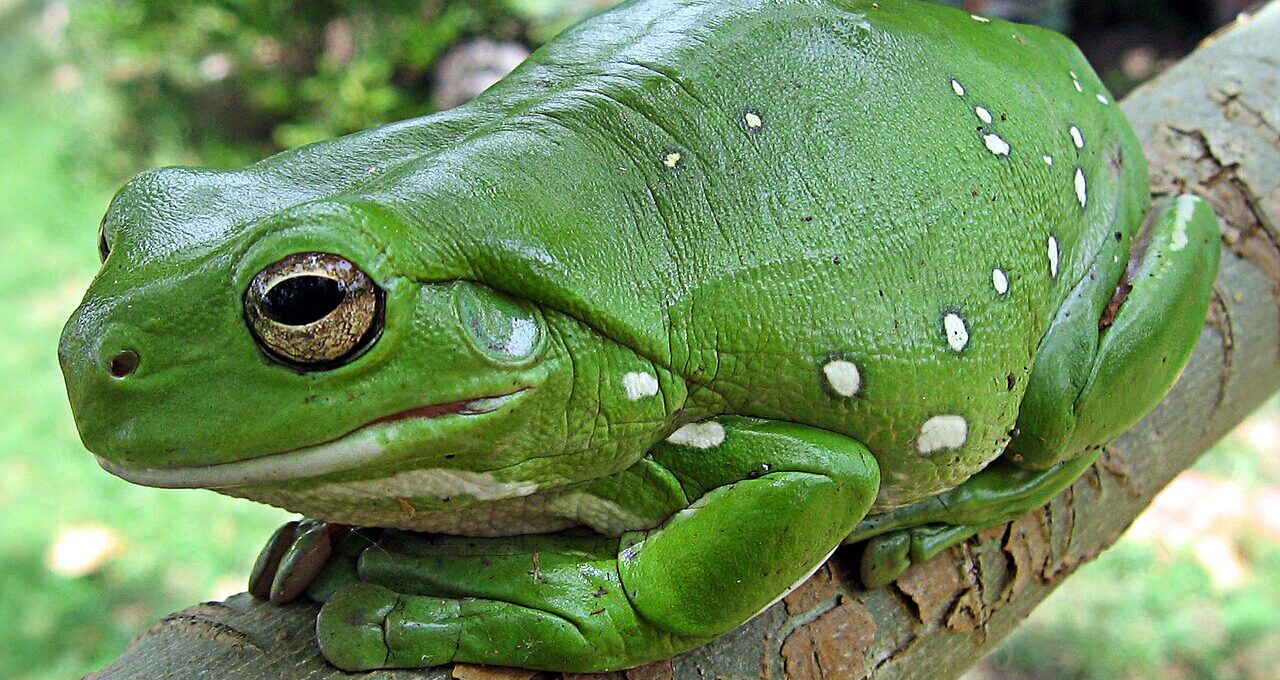

The Australian green tree frog is a fascinating and resilient amphibian native to Australia and New Guinea, valued for both its ecological role and its popularity as an exotic pet. Its vibrant color, distinctive vocalizations, and unique adaptations draw interest from scientists and nature enthusiasts alike.
Physical Appearance and Characteristics
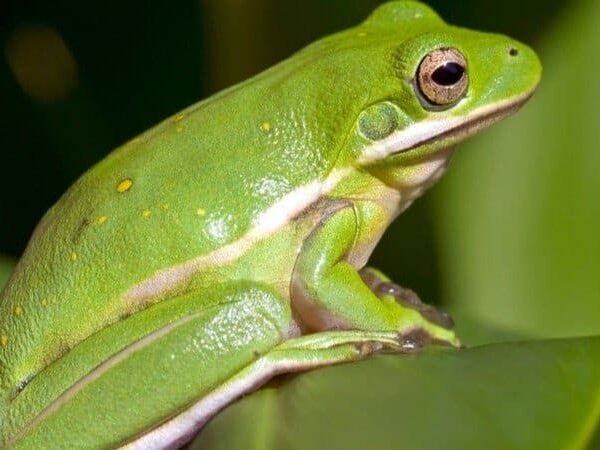
The Australian green tree frog is one of the largest frogs native to Australia, with adults reaching up to 11.5 cm (4.5 in) in length. Females are typically larger than males. Their coloration ranges from brownish or greyish-green to bright emerald green, influenced by temperature and environment. A distinctive fatty ridge above the eye and a moderately large parotoid gland are notable physical features. The frog’s underside is creamy-white and rough-textured, while the eyes are golden with horizontal slits. The limbs are short and robust, ending in adhesive discs that enable tree climbing. Webbing is more extensive on the toes than on the fingers, supporting their arboreal lifestyle. Occasionally, small, irregular white spots appear on their backs.
Taxonomy and Scientific History
Belonging to the family Hylidae and the subfamily Pelodryadinae, the green tree frog represents a group endemic to Australia and New Guinea. John White first described the species in 1790, which originally bore the name “blue frog” (Rana caerulea) due to preservation-induced color changes in early specimens sent to England. This historical quirk influenced the species’ Latin name, caerulea, meaning “blue”. Recent genetic studies have revealed that what was once classified as Litoria caerulea is actually a species complex, including closely related species like Litoria mira.
Natural Distribution and Habitat
Native green tree frogs inhabit northern and eastern Australia and the lowlands of New Guinea, thriving in warm, wet tropical climates. They are particularly abundant in regions ranging from Western Australia’s Kimberley, through the Northern Territory and Queensland, down to central New South Wales and parts of South Australia. Their total range covers over 4 million km². Introduced populations have appeared in Florida, USA, though such populations are small and limited. Historical introductions in New Zealand have expired, with no sightings reported since the 1950s.
Habitat preferences are diverse. Green tree frogs favor moist forests, eucalyptus stands with water-filled hollows, marshes, swamps, and grasslands in cooler areas. They commonly live near human dwellings, found inside houses, on window sills, under cistern rims, and in garden downpipes. This close association with people is due to their ability to exploit cool, damp microhabitats and their tolerance of environmental disturbance.
Behavior and Ecology
Green tree frogs are nocturnal and highly docile, unafraid of humans. They begin calling and hunting for food in the early evenings, especially during spring and summer. During the day, they seek refuge in cool, moist places like tree holes, rock crevices, or even household sinks. This species is not exclusively a rainforest dweller but relies on frequent rainfall to maintain skin moisture. Their waxy skin coating reduces evaporative water loss, and in dry conditions, they burrow or form cocoons composed of shed skin and mucus, avoiding desiccation.
Their diet primarily consists of insects such as moths, cockroaches, locusts, and spiders, but they also consume smaller frogs and even small mammals like bats. Food is captured either by flicking their sticky tongues or, for larger prey, by pouncing and pushing the prey into their mouths with their hands. The frog’s dental structure is suited for swallowing rather than cutting up food.
Vocalizations and Communication
Males give a distinctive low “brawk-brawk-brawk” call, repeated many times from elevated positions in trees or gutters. During breeding season, frogs descend to pond edges and pools to call and breed. In addition to mating calls, green tree frogs vocalize to advertise their presence and emit stress calls when threatened or touched, which can be a scream or squeak. This vocalization is particularly intense after rainfall, though the evolutionary reason behind this behavior is still unclear.
Reproduction and Lifecycle
Breeding occurs from November to February, coinciding with Australia’s summer and wet season. Males call near still water sources, such as ponds, swimming pools, or water tanks. Females lay clutches of 200 to 2000 eggs that initially float but sink after 24 hours. Tadpoles hatch measuring about 8 mm, growing up to 44 mm before undergoing metamorphosis around six weeks later. Tadpoles change color and pattern as they mature, eventually emerging from the water as juvenile frogs.
Adaptations for Moisture Retention
Green tree frogs possess two unique hydration adaptations. First, they can absorb condensation directly through their skin—a process enhanced by hygroscopic secretions from their parotoid glands that they spread across their bodies through wiping behavior. Second, they have a reduced rate of evaporative water loss, aided by their waxy skin and their behavior of seeking damp environments. These adaptations help them survive in both tropical and semi-arid habitats where moisture availability varies.
Predators and Threats
Native predators of the green tree frog include snakes and birds. The arrival of European settlers introduced domestic animals such as dogs and cats, which also prey on these frogs. In suburban areas, threats further include pollution, habitat loss, and new diseases—most notably the chytrid fungus (Batrachochytrium dendrobatidis), which has devastated many amphibian populations worldwide. Green tree frogs show some resistance to the fungus due to protective skin secretions, but local populations can still be affected.
Conservation Status
Currently, the Australian green tree frog is classified by the International Union for Conservation of Nature (IUCN) as “least concern,” reflecting its broad distribution, large population, and ability to thrive in diverse habitats. Australian law also protects the species under the Environment Protection and Biodiversity Conservation Act 1999. While populations appear stable, local declines do occur—especially where pollution, disease, and urbanization impact their environment. In New Guinea, harvesting for the pet trade may threaten specific populations, though successful captive breeding programs exist in Australian zoos.
Role in Research and Medicine
Green tree frogs play a vital role in scientific research. Their skin secretions contain a range of bioactive peptides, including caerins and caeruleins. Caerins have powerful antibacterial and antiviral properties, while caeruleins act as digestive hormones and hunger suppressants. These compounds have inspired new avenues in pharmaceutical development and are being studied for treatments against various human diseases, including HIV. Additionally, the unique structure of their toe pads has supported research into bioadhesive materials.
Green Tree Frogs as Pets
The Australian green tree frog is widely kept as a pet due to its calm temperament and ease of care. Their broad diet and resistance to diseases make them ideal for beginners. However, pet owners must be cautious of overfeeding, which can lead to obesity, manifesting as extra fat deposits around the head and body—the origin of the nickname “dumpy tree frog.” Pet frogs require habitats that mimic their natural moist environment and should be protected from exposure to poisonous prey such as North American fireflies, which are fatal to these frogs.
The Intrigue of the Australian Green Tree Frog
The green tree frog occupies a special place in the Australian ecosystem and culture. Its resilience and adaptability enable it to survive in variable climates and close proximity to humans. Scientists continue to discover new ecological and medical importance from its unique biology, while pet owners cherish them for their calm nature and longevity.
Key Facts at a Glance
- Scientific Name: Ranoidea caerulea (synonyms: Litoria caerulea, Pelodryas caerulea)
- Common Names: Australian green tree frog, White’s tree frog, dumpy tree frog
- Range: Northern and eastern Australia, New Guinea; introduced to Florida, USA
- Habitat: Moist forests, eucalyptus groves, marshes, swamps, grasslands, urban areas
- Lifespan: Up to 16 years in captivity; some live over 20 years
- Size: Up to 11.5 cm (4.5 in), females larger than males
- Diet: Insects, spiders, small mammals, smaller frogs
- Conservation Status: Least concern (IUCN)
- Unique Adaptations: Moisture retention, powerful skin secretions with medicinal properties
The Importance of Conservation
The health of amphibian populations like the green tree frog signals the overall wellbeing of ecosystems, acting as a “canary in the coal mine” for environmental changes. Continued research, responsible pet ownership, and habitat conservation efforts remain crucial for protecting this remarkable species against emerging threats and ensuring it thrives for future generations.